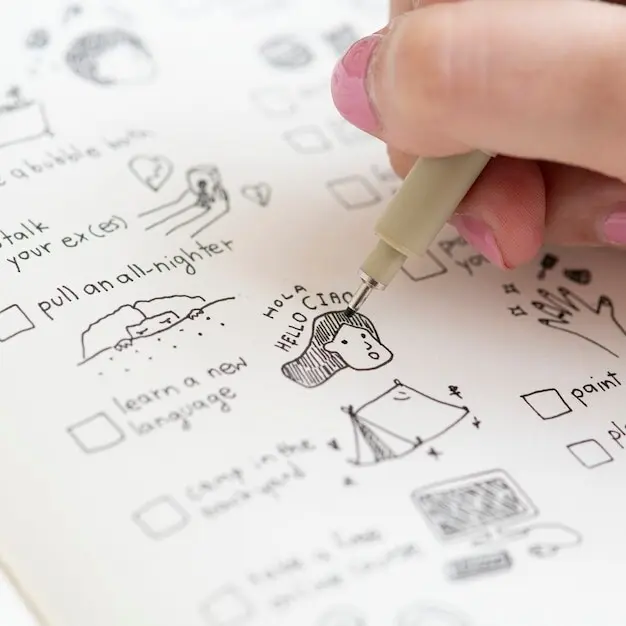
Sketch It, Remember It: What Science Reveals

Today we explore memory retention and comprehension with visual notes, guided by findings from cognitive psychology, education, and neuroscience. From dual coding and the picture superiority effect to the drawing advantage and spaced retrieval, discover how simple sketches, spatial layouts, and intentional structure can make ideas memorable, meaningful, and delightfully easier to recall when it matters most.

Why Pictures Anchor Memory

Decades of research show that pairing words with images creates multiple pathways for recall, strengthening recognition and understanding. Visual notes transform abstract information into concrete cues, lowering cognitive friction and inviting active meaning-making. Think of them as mental bookmarks you draw yourself, turning fleeting explanations into stable, retrievable structures that persist long after the lecture or meeting ends.

Crafting Notes That Stick

Icons As Micro‑Stories

A tiny magnet to denote attraction, a ladder for hierarchy, a bridge for transfer—icons compress rich meaning into a glance. Choose a consistent visual vocabulary so similar ideas always look similar. Over time, your pages become bilingual: words speak linearly, while icons whisper context, analogies, and reminders that your future self will instantly understand.

Layouts That Guide Understanding

Use spatial metaphors deliberately: timelines for sequences, cycles for processes, Venn diagrams for overlap, and clusters for categories. Arrows signal causality, dotted lines imply possibility, and borders define scope. Place definitions near examples, questions beside claims, and counterarguments within reach. The arrangement becomes an argument you can see, supporting comprehension during study and retrieval during performance.

Color, Contrast, And Hierarchy

Reserve color for meaning, not decoration. One hue for key ideas, another for evidence, a third for questions or risks. Thicker lines emphasize importance; lighter strokes suggest detail. Consistent markers create predictable landmarks across pages, accelerating scanning speed later. When every visual choice encodes purpose, your notes transform into an intuitive legend for complex thinking.

What The Research Reports

Multiple strands of evidence converge: drawing information enhances recall, concept mapping boosts transfer, and well-designed visuals improve learning outcomes—especially when paired with retrieval practice. Studies by Wammes and colleagues highlight the drawing effect; Mayer’s multimedia principles caution against overload; classroom interventions reveal sustained benefits when learners actively generate concise, structured visuals rather than passively copy slides.

From Recall To Understanding

Remembering facts matters, but comprehension requires structure, relationships, and purposeful practice. Visual notes support deeper processing by making assumptions visible, highlighting evidence chains, and surfacing gaps for targeted review. Pair your pages with retrieval and elaboration, and turn every diagram into a mini-lab where you test claims, challenge counterexamples, and consolidate meaning through active refinement.

Adapting Across Contexts

Visual notes flex across disciplines and settings: lectures, meetings, research articles, code reviews, and self-study. Tailor your approach to the material’s shape. Abstract theory wants metaphors; procedures want timelines; debates want contrasts. Match the form to the function, and your pages become living tools—portable, persuasive, and ready for rapid briefings or quiet weekend review.

Fast Talks And Meetings

For rapid presentations, use a two-column canvas: left for claims and decisions, right for actions and owners. Anchor each decision with a small icon, then draw a thin timeline along the bottom. During debriefs, the page doubles as a checklist, surfacing blockers and clarifying who does what before momentum evaporates into inbox fog.

Math, Code, And Data

Formulas and algorithms thrive as flow diagrams, variable boxes, and annotated examples. Show inputs, transformations, and outputs with precise arrows. For data stories, sketch axes, units, and hypotheses before plotting anything. This pre-visualization prevents chartjunk and focuses questions. Later, your concise diagram reminds you not just what computed, but why the approach fit.

Inclusive For Different Minds

Visual flexibility supports diverse cognitive styles, including ADHD and dyslexia. Chunking reduces overwhelm, icons anchor attention, and whitespace lowers noise. Offer alternative paths: audio explanations paired with visuals, color-safe palettes, and printable black-and-white versions. The aim is autonomy—empowering learners to customize scaffolds that respect strengths while gently supporting friction points without shame.

Tools, Routines, And Momentum

Consistency outperforms intensity. Choose a simple toolkit, design a repeatable workflow, and protect short review blocks on your calendar. The habit pays compounding dividends: each page becomes easier to create, patterns stabilize, and recall accelerates. Invite feedback, iterate responsibly, and celebrate small wins. Your notes evolve from artifacts into a resilient thinking system you trust.
Kiravirolivokentonarifari
Privacy Overview

This website uses cookies so that we can provide you with the best user experience possible. Cookie information is stored in your browser and performs functions such as recognising you when you return to our website and helping our team to understand which sections of the website you find most interesting and useful.